
The United Kingdom remains a top destination for international students, combining world-class education with vibrant…
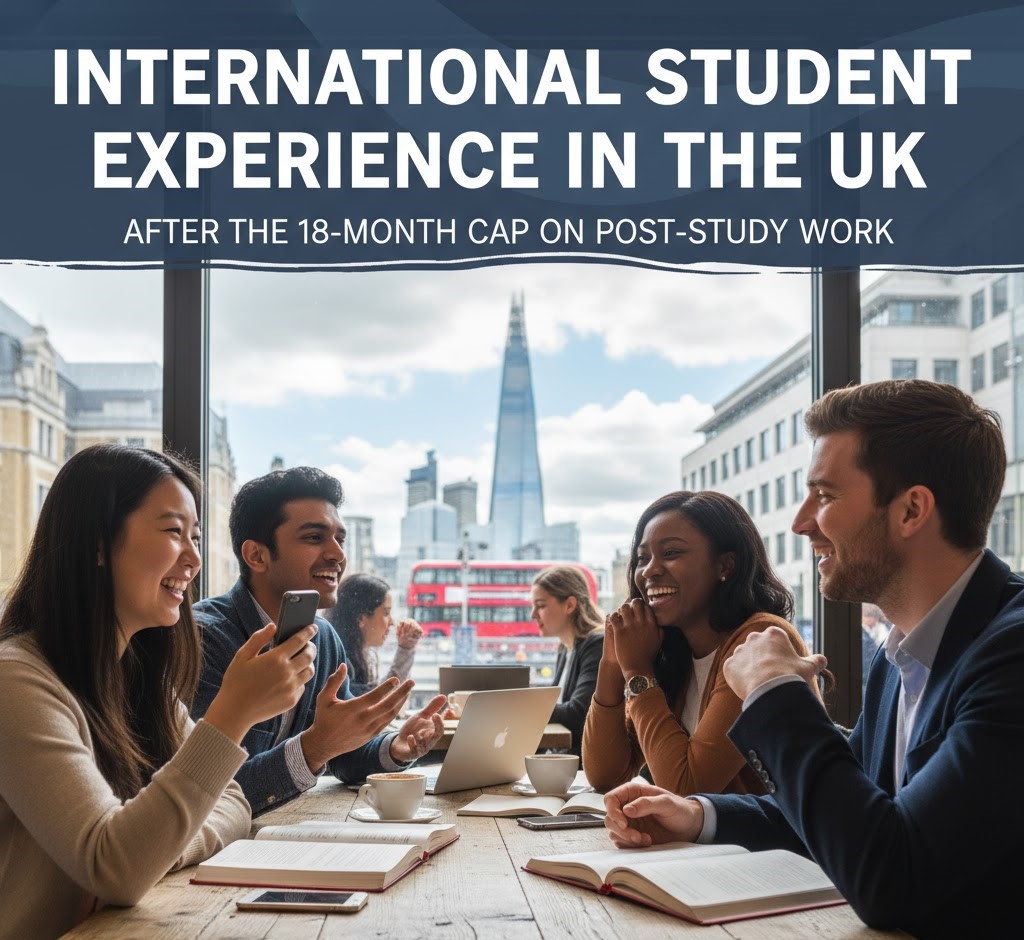
International Student Experience in the UK After the 18-Month Cap on Post-Study Work
Introduction
For many aspiring international students from South Asia, Southeast Asia and Africa, studying in the UK has offered more than just a degree — it has offered the chance to gain work experience, build networks and potentially transition into skilled employment. The route for this has been the Graduate Route (also known as the post-study work visa).
But now, the UK government has announced changes that alter the timeline. From 1 January 2027, most international graduates will only be eligible to remain in the UK for 18 months under the Graduate Route instead of the current two years. Careers360 Study Abroad+4The Financial Express+4Immigration Advice Service+4
In this article, we examine what this shift means for the student experience: application strategy, campus life, post-study work search and decision-making for students from our target regions.
1. What exactly is changing?
- Up until 31 December 2026, students who apply for the Graduate Route will be eligible for 2 years of post-study stay (and for PhD graduates, 3 years). The Economic Times+2Swansea University+2
- From 1 January 2027, for applications submitted on or after this date, the stay will be cut to 18 months for most international graduates (PhD route remains 3 years). Immigration Advice Service+2The Financial Express+2
- The Graduate Route cannot be extended, though graduates may switch into a different visa route (e.g., Skilled Worker) if they qualify. Swansea University+1
2. Why the change?
The UK government has cited several reasons:
- A significant number of international graduates under the Graduate Route were not moving into graduate-level employment within the allowed period. Immigration Advice Service+1
- Broader immigration reforms to reduce net migration and align the post-study work window more closely with employment outcomes. The Economic Times+1
- As part of this package, additional changes (like higher English-language requirements and increased maintenance funds) are also in play. The Financial Express+1
3. What this means for students from South Asia, Southeast Asia & Africa
1. Course & University Choice
Given the shorter post-study stay, students should emphasise:
- Universities and programmes with strong employment support and high graduate employment rates.
- Courses with clear pathways into industry, internships, and work-placements — these will help maximise time.
- Timing: if you plan to benefit from the longer 2-year window, ensure your application and Graduate Route application fall before end of 2026.
2. Early Job-Search Urgency
The 18-month window means less time to: secure a job, change visa route, or build a track record for sponsorship. Students must:
- Start networking and job applications early, ideally in the final year or during the course.
- Move from “just finishing the degree” to “focusing on securing a qualifying job” quickly.
- Explore multiple visa exit routes: switching to sponsored roles, or even considering returning home / other countries.
3. Cost-vs-Benefit Calculation
The UK remains a strong destination, but the change may tilt calculus for many:
- Is the extra cost of UK study justified given a shorter stay?
- For students from South Asia & Africa (where cost sensitivity is higher), the post-study work benefit was a major pull factor. With a shorter stay, alternatives (Canada, Germany, Sweden, Australia) may look more attractive.
- Hence, prospective students should build both Plan A (UK) and Plan B (other destinations) simultaneously.
4. Current students & those already in process
For those already studying or whose applications are submitted before the new rule:
- You will likely still be eligible for the 2-year stay if you apply for Graduate Route before the cut-off.
- However, longer-term planning (visa sponsorship, settlement) still needs attention.
- Keep abreast of any further policy changes — these are likely in a reform-intensive era.
4. Student Experience: Beyond the Visa Window
Campus life & expectations
While the policy affects the post-study window, many underlying aspects of student life remain consistent: global peer-groups, university resources, cultural exposure. However, students say:
“I completed my Master’s … and am now in the job market… I’m naturally curious about how others sharing my circumstance are doing right now.” – Reddit
“I did my BEng (Hons)… I genuinely believed coming here would change my life — and in many ways, it did. But now I’m feeling lost.” – Reddit
Such sentiments reflect a growing realism among international students: university is about the degree plus the “second phase” of work — and the shortened period puts pressure on that second phase.
Work rights & transitions
- Under the Graduate Route you can work full-time, be self-employed or start a business (within the post-study timeframe). Careers360+1
- After the post-study window, to remain you’ll need to switch into a skilled-worker category (which itself has requirements: salary thresholds, job eligibility, employer sponsorship).
- The shorter window means you may have less breathing room to find the “right job” or prepare for visa switching.
5. Practical Strategy & Tips for Applicants
- Apply early: If your timeline allows, aim for course start and visa submission such that your Graduate Route application occurs by 31 Dec 2026, securing the 2-year stay.
- Select programmes strategically: Look for universities with high employability rates, good career services, and strong industry links.
- Begin job-search early: In your final or even penultimate year — pursue internships, networking, and career fairs. Use your university’s graduate-employability office aggressively.
- Budget realistically: Factor in the reduced post-study timeframe when evaluating return on investment (ROI); plan for a shorter earnings period in the UK.
- Explore alternatives: Even while planning for the UK, investigate Canada, Germany, Sweden etc. as backup or dual-destination options.
- Visa-switching awareness: Understand the requirements for moving from Graduate Route to Skilled Worker visa (salary, job type, employer). Time is of essence.
- Stay informed: Immigration policy is in flux; monitor official sources like UK Visas and Immigration (UKVI) and credible advisories.
6. Looking Ahead: What to Expect
- Universities may respond to the policy by strengthening their employability offerings to maintain attractiveness to international students.
- Some students may shift to shorter courses or one-year masters and leave sooner; others may favour countries with more generous post-study work rights.
- The UK’s international-student market may see a restructure: fewer but more selective, with higher emphasis on quality and employability.
- For students from South Asia, Southeast Asia & Africa: the UK remains viable — but the window to leverage study into work and migration is narrowing, so decision-making must be sharper.
Conclusion
The reduction of the post-study work window from two years to 18 months for most international graduates in the UK marks a meaningful shift — not an end to opportunities, but a recalibration of them.
For international students from South Asia, Southeast Asia and Africa, the message is clear: make your move count. Choose your course wisely, engage with your career path early, budget for a leaner post-study phase, and prepare for flexibility. The UK can still be an excellent destination — but the timeline is tighter and the strategy must be stronger.
Read Our Other Helpful Guides
Related Posts



Comments (0)