
The United Kingdom remains a top destination for international students, combining world-class education with vibrant…

How AI is Changing University Admissions in 2025
University admissions in 2025 are no longer entirely human-driven. From scanning personal statements to predicting student success, artificial intelligence (AI) has become deeply embedded in the admissions process across hundreds of universities worldwide.
For international students, this shift brings both opportunity and uncertainty. While AI can speed up decisions and reduce paperwork delays, it also introduces new challenges related to fairness, transparency, and data privacy. Understanding how AI works — and how universities use it — is now essential for applicants preparing competitive applications.
How AI Is Being Used in University Admissions
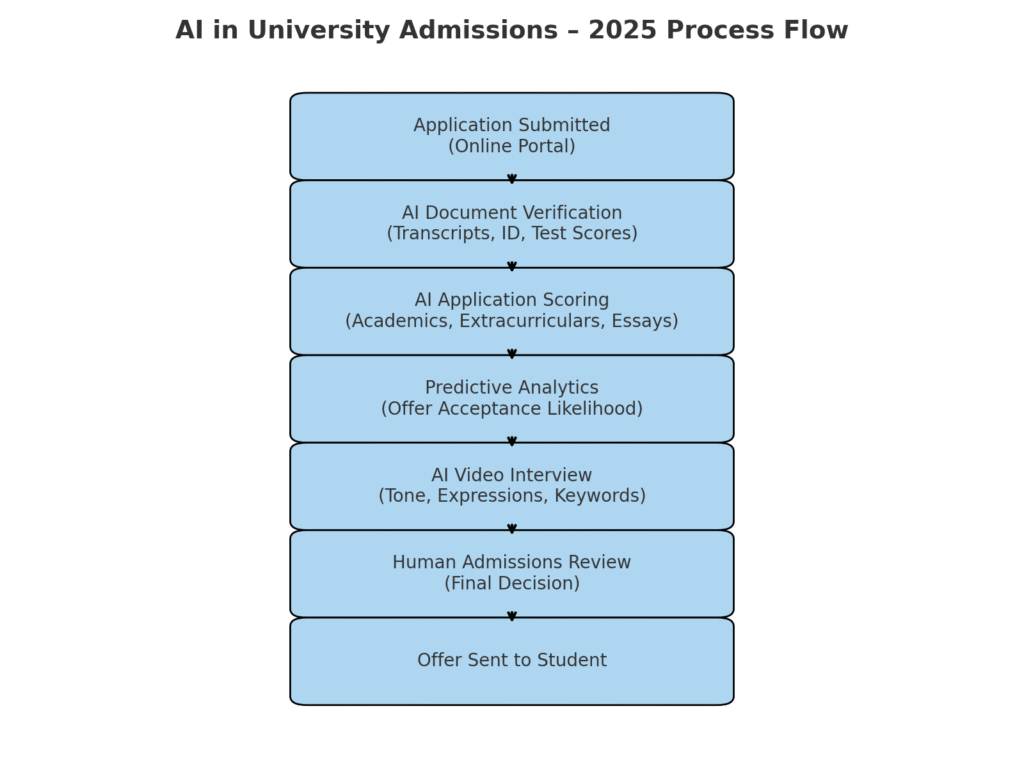
1. Document Verification
AI systems rapidly verify academic transcripts, passports, language test scores, and financial documents. By detecting inconsistencies or forged records, universities reduce fraud while accelerating conditional offer letters.
Many institutions now rely on automated verification tools to screen large volumes of applications efficiently, especially from high-demand regions.
2. Application Scoring & Ranking
Machine learning algorithms assess academic performance, extracurricular involvement, recommendation letters, and personal statements. These systems compare applicants with historical data from previously successful students.
While AI does not usually make final decisions, it helps admissions teams shortlist candidates more efficiently.
3. Predictive Analytics
AI models estimate which applicants are likely to accept offers, complete their degrees, or require additional academic support. Universities use these predictions to manage enrollment targets and allocate scholarships more strategically.
This data-driven approach allows institutions to balance diversity, retention rates, and institutional capacity.
4. AI-Assisted Video Interviews
Some universities now conduct AI-supported video interviews that analyze speech patterns, clarity, confidence, and communication style. These tools are typically used for early-stage screening rather than final decisions.
Benefits of AI for International Students
- Faster Decision Timelines: Application reviews that once took months may now conclude in weeks.
- Improved Accessibility: AI translation and language-assistance tools help non-native English speakers express themselves more clearly.
- Program Matching: AI can suggest alternative courses or campuses better aligned with a student’s academic background.
According to Top Universities, AI adoption has significantly reduced processing backlogs at major institutions.
Concerns & Ethical Challenges
- Bias & Fairness: AI systems trained on historical data may unintentionally reinforce existing inequalities.
- Reduced Human Context: Unique personal challenges may not be fully captured by algorithms.
- Data Privacy: Sensitive personal information is often processed by third-party platforms.
Organizations like UNESCO have called for ethical oversight to ensure AI remains transparent and inclusive in education.
How to Adapt Your Application for AI Screening
- Use clear and structured language: AI prioritizes clarity over decorative writing.
- Align keywords with course requirements: Match terminology used in official program descriptions.
- Ensure consistency: Academic records, resumes, and statements should align across documents.
- Prepare for AI-assisted interviews: Speak naturally, maintain eye contact, and answer concisely.
Admissions experts at Inside Higher Ed emphasize that authenticity still matters — even in AI-screened applications.
The Future of AI in Admissions
AI is unlikely to fully replace human admissions officers. Instead, it acts as a decision-support tool that helps universities manage volume, identify potential, and improve efficiency.
Institutions are increasingly combining AI insights with human judgment to ensure balanced outcomes. Regulatory bodies and academic councils are also pushing for clearer disclosure on how AI influences admission decisions.
According to research published by The World Economic Forum, transparency and accountability will define the next phase of AI adoption in higher education.
Final Advice:
AI is reshaping admissions — but it hasn’t removed the human element. International students should aim to create applications that are both data-friendly and emotionally engaging.
Focus on clarity, consistency, and relevance while still telling a genuine personal story. When used wisely, AI can become an advantage rather than a barrier in your study abroad journey.
Read Our Other Helpful Guides
Related Posts



Comments (0)